Most Growing Businesses Don’t Have a Hiring Problem. They Have a Systems Problem.
Every successful business eventually reaches the same point.
Manual work starts piling up. Reports take hours to prepare. Managers spend more time collecting information than making decisions. Teams bounce between spreadsheets, emails, CRMs, Slack conversations, accounting software, and project management tools just to understand what’s happening.
The natural reaction is to hire more people.
The smarter approach is to build better systems.
At HyperTrends, we experienced these growing pains firsthand while scaling two companies. Instead of adding more operational overhead, we began building AI-powered internal tools designed specifically for the way we work.
Today, we’ve developed more than 50 internal software modules as part of our Software Factory, helping us automate repetitive work, improve visibility across the organization, and free our teams to focus on higher-value work.
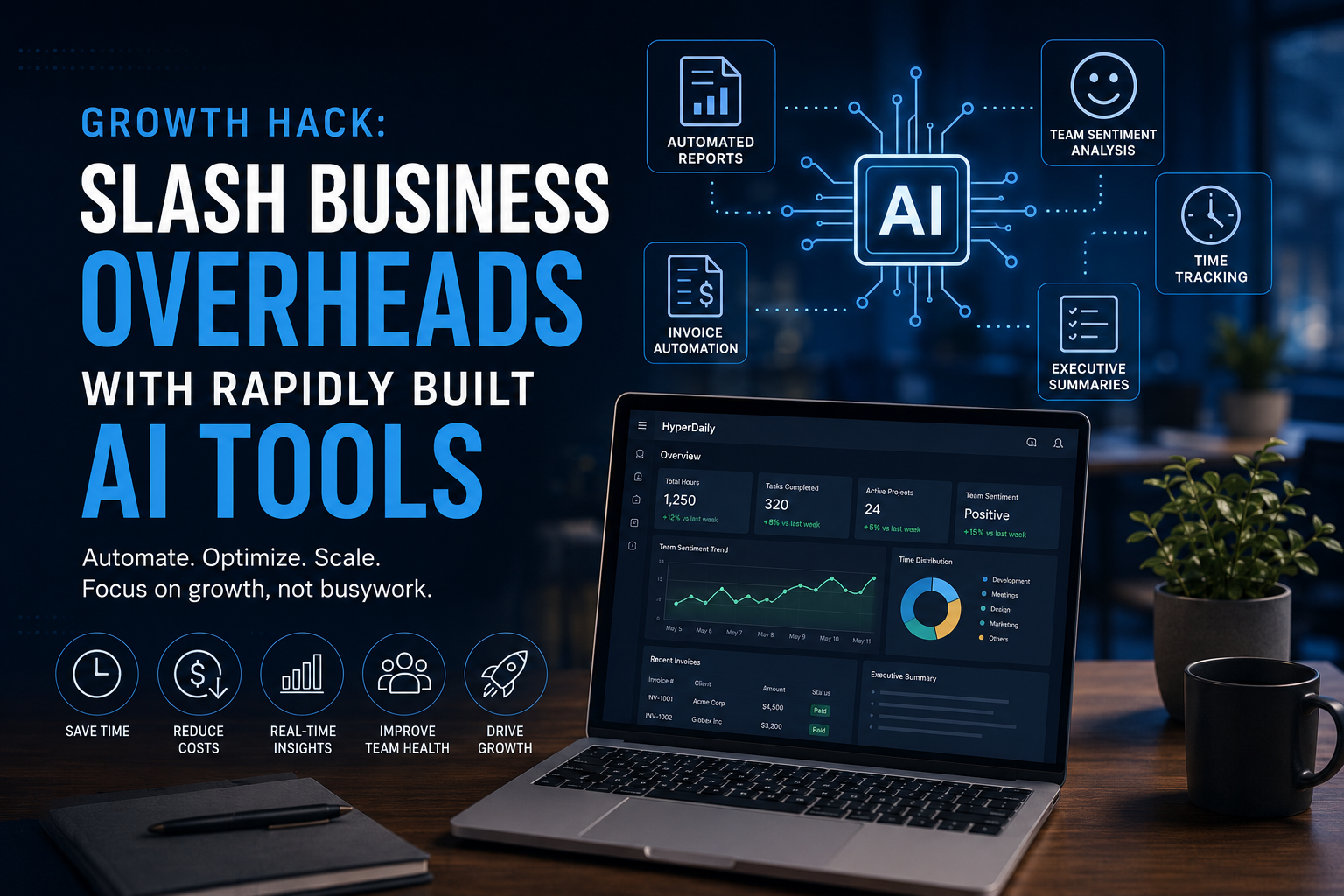
One of those tools is HyperDaily—an AI-powered operational assistant that automates reporting, tracks team sentiment, manages time tracking, generates executive summaries, and streamlines invoicing.
The lesson was simple:
The companies that scale fastest aren’t necessarily the ones that hire the fastest. They’re the ones that automate the smartest.
Why AI Internal Tools Matter More Than Ever
Every growing company eventually faces the same challenge: operational complexity.
As teams expand, so do the number of systems they depend on. Information becomes fragmented across multiple applications, creating bottlenecks that slow decision-making and increase costs.
Without realizing it, businesses begin paying highly skilled employees to perform repetitive administrative work instead of solving customer problems or driving innovation.
Internal AI tools reverse that trend.
Rather than forcing employees to manually gather information, intelligent software continuously collects, organizes, summarizes, and delivers the insights leaders need to make better decisions.
Employees stop acting like data collectors and start acting like decision-makers.
The Business Case for Building Internal AI Tools
Building internal software isn’t just about automation.
It’s about creating operational leverage.
At HyperTrends, HyperDaily helped eliminate:
- More than 5 hours per week of manual data collection.
- Approximately 2 additional hours spent preparing executive summaries and invoices.
- Numerous interruptions caused by recurring status meetings.
Seven hours saved every week quickly compounds across an entire organization.
Instead of investing those hours in repetitive administration, teams can focus on product development, customer success, sales, marketing, and strategic initiatives that actually grow the business.
Which Processes Should You Automate First?
The best candidates for automation are repetitive, predictable, and data-driven.
Examples include:
- Daily operational reports
- Executive summaries
- Time tracking
- Invoice generation
- KPI dashboards
- CRM updates
- Customer follow-ups
- Internal reminders
- Meeting summaries
- Approval workflows
These processes rarely require creativity, yet they consume an enormous amount of time.
AI executes them faster, more consistently, and with fewer errors.
As we often say:
A process is communicated. A tool is programmed. The latter leaves far less room for error.
AI Gives Leaders Better Visibility
One of the biggest advantages of AI isn’t replacing people.
It’s giving managers better information.
HyperDaily continuously monitors operational signals and team sentiment, helping identify potential issues before they become expensive problems.
Instead of discovering burnout after an employee resigns, leaders can recognize trends early and take action sooner.
That enables:
- Better coaching
- Faster one-on-one conversations
- Improved employee engagement
- Stronger decision-making
- Healthier organizational culture
AI doesn’t replace leadership.
It amplifies it.
Build Faster with the DIDI Framework
Many organizations assume building internal software requires months of development.
That assumption is becoming outdated.
Our DIDI Framework—Discover, Ideate, Develop, Iterate—focuses on solving one problem at a time.
Rather than spending months building a perfect application, we rapidly identify operational pain points, launch lightweight solutions, collect feedback, and continuously improve them.
This iterative approach dramatically reduces development time while ensuring every tool delivers measurable business value.
Small improvements delivered consistently often outperform massive software projects that never reach production.
Why Product Ops Makes Internal Tools Even More Powerful
Technology alone doesn’t solve operational problems.
Processes do.
Product Operations connects teams, systems, and workflows around shared data and shared objectives.
When internal tools are designed around Product Ops principles, departments stop operating in silos.
Product, Engineering, Customer Success, Operations, Finance, and Leadership all work from the same information.
That alignment improves collaboration, accelerates decision-making, and creates an organization capable of adapting much faster as it grows.
Low-Code and AI Have Changed Software Development Forever
Building software is no longer limited to large engineering teams.
Today’s organizations can combine technologies like ChatGPT, APIs, Zapier, Microsoft Power Automate, Google Workspace, and modern low-code platforms to automate workflows that previously required significant custom development.
For more advanced requirements, custom engineering can extend these systems even further.
The result is a new generation of internal software that can be developed in weeks instead of months while delivering immediate operational impact.
The Real Competitive Advantage
Every company can buy the same CRM.
Every company can subscribe to the same project management platform.
Every company can purchase the same AI assistant.
Very few companies build software specifically around their own business.
That’s where the real competitive advantage lives.
Internal AI tools capture your organization’s unique processes, automate repetitive work, improve decision-making, and evolve alongside your business.
Instead of adapting your company to generic software, your software adapts to your company.
Competitors can copy your products.
They can’t easily copy your operating system.
Final Thoughts
Operational overhead is one of the biggest hidden costs inside growing businesses.
Hiring more people isn’t always the answer.
Often, the answer is building better systems.
Our experience developing HyperDaily—and more than fifty additional internal software modules—has shown that relatively small investments in internal AI tools can generate outsized returns in productivity, operational visibility, employee satisfaction, and long-term scalability.
The companies that win over the next decade won’t simply use AI to create content.
They’ll use AI to build better businesses.
For more contact us at HyperTrends
Frequently Asked Questions
What are AI internal tools?
AI internal tools are software applications built specifically for a company’s internal operations. They automate repetitive work, connect business systems, improve reporting, and help employees make faster, better decisions.
How much time can internal AI tools save?
Many businesses recover several hours every week by automating reporting, invoicing, time tracking, approvals, and recurring operational workflows.
What should businesses automate first?
Start with repetitive, rules-based processes such as reporting, KPI dashboards, CRM updates, executive summaries, customer notifications, and invoice generation.
Do I need a large engineering team?
No. Modern AI platforms, APIs, and low-code tools allow organizations to build powerful internal software with far fewer engineering resources than was possible just a few years ago.
Why build internal tools instead of buying another SaaS platform?
Generic software solves generic problems. Internal tools are designed around your unique workflows, giving your business greater efficiency, flexibility, and a competitive advantage that off-the-shelf platforms can’t easily provide.

