
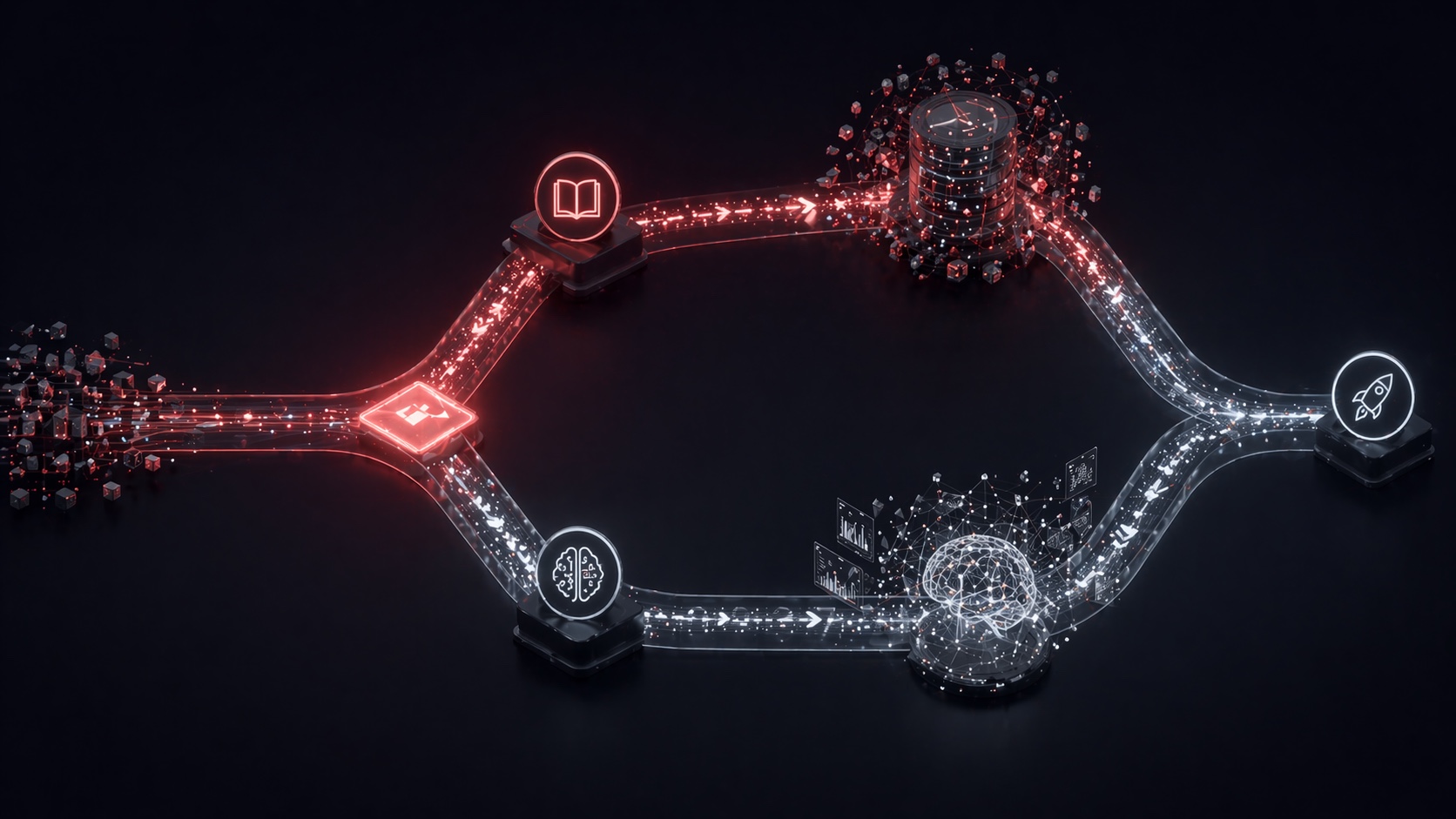
RAG vs fine-tuning: which should enterprises use?
RAG should be used when the problem requires accessing dynamic or factual knowledge, while fine-tuning is best when the model must change behavior, such as tone, structure, or domain-specific reasoning. Many enterprise systems require a hybrid approach combining both.
Why choosing the wrong approach is expensive
You spent $80K fine-tuning a model that RAG could have handled in two hours.
A Fortune 500 client fine-tuned GPT-4 on internal data:
- 3 months
- $80,000
- +6% performance gain
- 15% hallucination rate
We rebuilt it using RAG:
- 2 weeks
- $8,000
- 2% hallucination rate
Why? Because RAG retrieves facts. Fine-tuning does not.
Choosing the wrong architecture creates compounding waste — the same kind of inefficiency seen in broader enterprise AI architecture decisions.
The core distinction: knowledge vs behavior
RAG answers: What does the model need to know?
- Retrieves documents at runtime
- Keeps knowledge outside the model
- Enables real-time updates
Fine-tuning answers: How should the model behave?
- Modifies model weights
- Learns tone, format, reasoning
- Improves consistency
Decision logic
- Need facts → RAG
- Need behavior → Fine-tuning
- Need both → Hybrid
RAG architecture for enterprise
What is a RAG pipeline?
User Query → Retrieval → Context → LLM → Response
Offline: Documents → Embeddings → Vector Database
1. Document chunking (most important factor)
Chunking determines retrieval quality more than model choice.
Best approach:
- Semantic chunking (by sections)
- 15% overlap
Poor chunking = poor answers.
2. Embedding models
Used to convert text into vectors.
- High quality → better retrieval
- Lower cost → better scale
3. Vector database selection
Common options:
- Managed → Pinecone
- Flexible → Weaviate
- Open-source → Qdrant
Choice depends on scale, cost, and control.
4. Retrieval strategy
Production systems use:
- Hybrid search (vector + keyword)
- Re-ranking
- Query expansion
- Metadata filtering
These patterns are core to modern AI agent system architectures.
When should you use fine-tuning?
Fine-tuning is the right choice when behavior matters:
- Structured outputs (JSON, schemas)
- Domain reasoning (legal, medical, finance)
- Brand voice
- Task specialization
Fine-tuning pipeline
Data → Validation → Training → Evaluation → Deployment
Requirements:
- 100–10,000 high-quality examples
- Real-world distribution
- Human validation
Cost comparison: RAG vs fine-tuning
| Approach | Setup | Cost per query | Updates |
|---|---|---|---|
| RAG | Low–Medium | Medium | Instant |
| Fine-tuning | Medium–High | Low | Expensive |
| Hybrid | Medium | Medium | Mixed |
Key insight:
RAG is 3–10x cheaper for knowledge problems
The enterprise decision framework
Use RAG if:
- Knowledge changes frequently
- Source attribution is required
- Cost efficiency matters
Use fine-tuning if:
- Latency must be extremely low
- Behavior must be consistent
- Tasks are repetitive
Use hybrid if:
- You need both knowledge and behavior
- You want cost + performance optimization
This layered approach aligns with cloud-native AI architecture patterns.
The hybrid architecture (best of both)
Most enterprise systems converge on hybrid:
- Fine-tuned model → handles structure & routing
- RAG system → handles knowledge
Flow:
- Fine-tuned model processes request
- Calls RAG when knowledge is needed
- Combines outputs
Result:
- Lower cost
- Higher accuracy
- Better scalability
How to evaluate performance
RAG metrics
- Recall@K
- Precision@K
- MRR
Generation metrics
- Faithfulness
- Relevance
- Hallucination rate
Business metrics
- Cost per query
- Task success rate
- User satisfaction
These evaluation layers are critical in enterprise AI deployment strategies.
The Bottom Line
RAG and fine-tuning are not interchangeable.
They solve fundamentally different problems:
- RAG = knowledge
- Fine-tuning = behavior
The companies that understand this distinction build faster, cheaper, and more reliable AI systems.
The ones that do not waste $80K solving the wrong problem.
What HyperTrends Builds
HyperTrends designs enterprise LLM systems:
- RAG pipelines
- Fine-tuning workflows
- Hybrid architectures
Ready to choose the right architecture the first time?
👉 Schedule a consultation and design your enterprise LLM strategy.

