
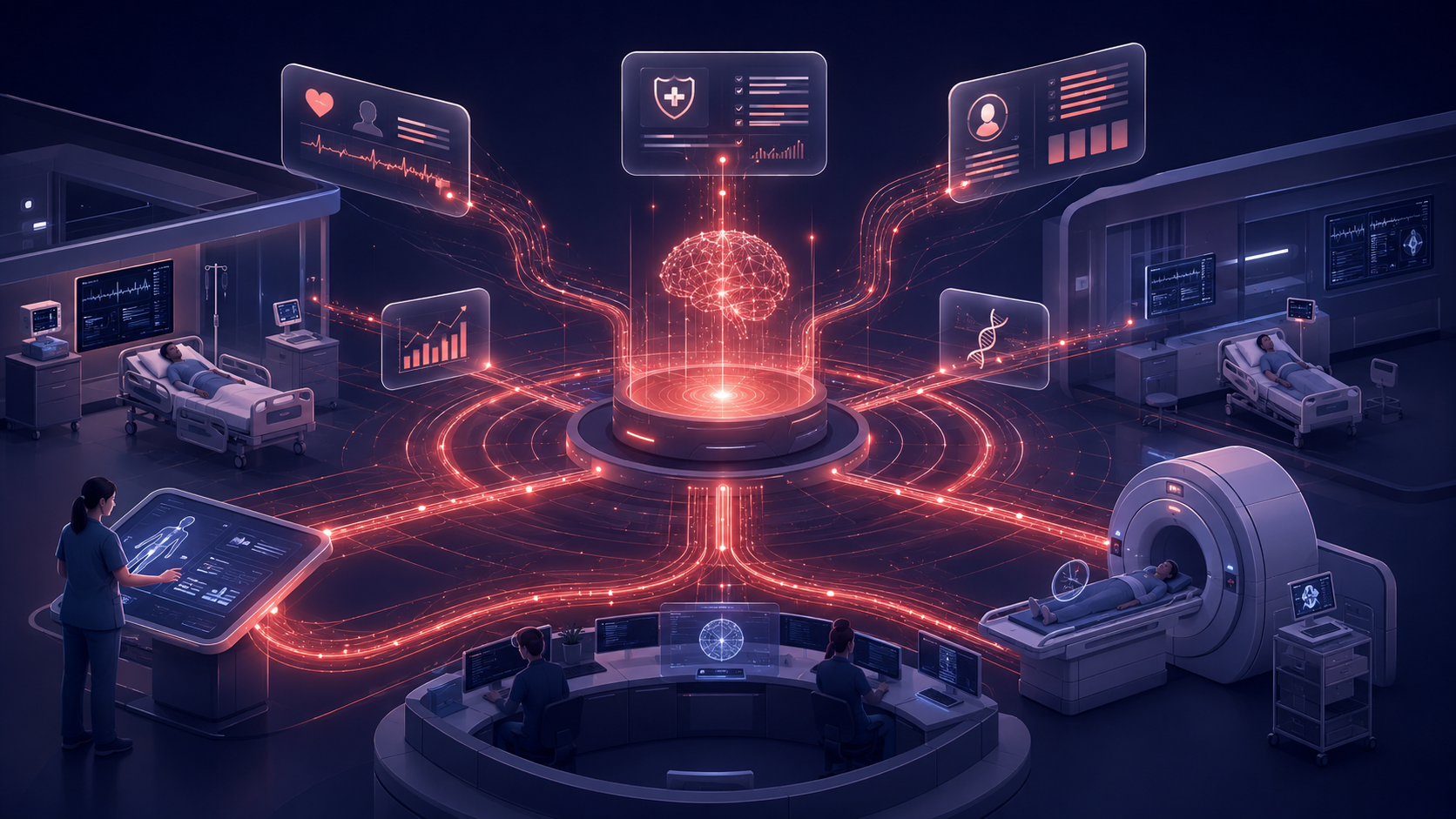
Healthcare Software Is Broken. AI Is Not the Fix. AI-Native Architecture Is.
The U.S. healthcare system spends over $300 billion annually on information technology. More than half of that — over $150 billion in annual healthcare IT waste — is lost to disconnected systems, redundant software, manual workarounds, and technology that actively slows down healthcare workers instead of helping them.
The instinct is to throw AI at the problem. Add a chatbot. Deploy a prediction model. Sprinkle machine learning onto the dashboard.
But bolting AI onto broken architecture does not fix the architecture. It creates a new layer of complexity on top of existing dysfunction. The chatbot hallucinates because it is trained on fragmented data. The prediction model drifts because the data pipeline is batch-delayed by 24 hours. The dashboard AI becomes ineffective because the interface treats every user the same regardless of expertise.
The fix is not AI.
The fix is AI-native architecture — systems designed from the ground up for:
- Real-time data flow
- Adaptive user experiences
- Intelligent clinical decision support
- Compliance-by-design healthcare systems
AI becomes powerful when the architecture supports it. Without that architecture, AI is just an expensive experiment.
This guide covers every layer of modern AI healthcare software architecture in 2026.
Part 1: The Problem — Why Healthcare Software Fails
Healthcare software fails for a structural reason: it treats every user the same.
A cardiologist with 14 years of experience and a front-desk coordinator who started last week often navigate identical interfaces.
The cardiologist is slowed by onboarding prompts and confirmation dialogs designed for beginners. The coordinator is overwhelmed by dense terminology and clinical workflows designed for experts.
Both lose time. Both become frustrated.
This one-size-fits-all UX problem costs the healthcare industry billions annually in:
- Training costs
- Clinical errors
- Expert burnout
- Workflow inefficiency
- Operational workarounds
The deeper breakdown of this challenge is covered in Why Healthcare Software Fails: The One-Size-Fits-All UX Problem.
The quantified impact is massive. More than $150 billion in annual healthcare IT waste is tied to:
- Redundant systems
- Integration failures
- Vendor lock-in
- Training inefficiencies
- Manual operational workarounds
Part 2: Modernization — From Legacy to AI-Native
Most healthcare systems still run on infrastructure designed before modern cloud computing existed.
Modernizing healthcare software requires a progressive strategy — not a full rip-and-replace migration.
The Healthcare Modernization Maturity Model includes five stages:
Level 1: Legacy Monolith
Traditional tightly coupled hospital systems with minimal interoperability.
Level 2: API-Wrapped Legacy
Legacy systems remain in place while APIs expose core functionality externally.
Level 3: Hybrid Architecture
Extracted services combined with event-driven workflows and shared data streams.
Level 4: Cloud-Native Platform
Containerized microservices with scalable infrastructure and FHIR-native architecture.
Level 5: AI-Native Architecture
AI becomes a first-class architectural layer embedded directly into workflows, pipelines, and decision support systems.
Each stage delivers standalone value without requiring massive multi-year migration risk.
A deeper breakdown of progressive modernization strategies is covered in Healthcare Software Modernization: From Legacy Systems to AI-Native Architecture.
Part 3: Integration — Making Systems Talk
The average hospital operates more than 16 disconnected software systems that exchange information through manual workflows, spreadsheets, delayed synchronization, and batch file transfers.
Modern healthcare systems require real-time interoperability.
There are three major integration patterns used in healthcare today:
Point-to-Point Integration
Direct connections between systems.
Problem:
- Difficult to scale
- Fragile dependencies
- High maintenance burden
Integration Engine Architecture
A centralized engine manages communication between healthcare systems.
Better than point-to-point architecture, but often creates bottlenecks at scale.
Event-Driven FHIR Architecture
The modern target architecture.
Built around:
- Real-time event streams
- FHIR APIs
- Loosely coupled services
- Standardized interoperability
FHIR R4 has become the common language of healthcare interoperability.
Combined with SMART on FHIR and CDS Hooks, healthcare organizations can finally build modular healthcare ecosystems.
A full technical breakdown is covered in EHR Integration Architecture: Building Systems That Actually Talk to Each Other.
Part 4: Data Pipelines — Real-Time Clinical Insights
Healthcare data arrives in multiple formats:
- HL7 v2
- FHIR
- Custom APIs
- Device streams
- File drops
- Third-party integrations
Modern healthcare platforms must transform, validate, and distribute this information in real-time.
The five-layer healthcare pipeline includes:
Ingestion
Multi-format intake with canonical transformation at entry.
Processing
Streaming pipelines for clinical alerts and batch pipelines for analytics workloads.
Data Quality
Schema validation, clinical range checking, and deduplication processes.
Storage
- Hot storage for operational systems
- Warm storage for analytics
- Cold archival storage
Insight Delivery
Real-time:
- Clinical alerts
- Operational dashboards
- CDS triggers
- Population health analytics
The key architectural decision is not streaming versus batch.
Modern healthcare systems require both.
The complete architecture is explored in Healthcare Data Pipeline Architecture: From Ingestion to Real-Time Clinical Insights.
Part 5: Compliance — HIPAA-Compliant AI
AI in healthcare must comply with the same HIPAA Security Rule and Privacy Rule requirements as every other system handling PHI.
Modern AI healthcare systems must address:
De-Identification
Use de-identified datasets for training whenever possible. PHI exposure should remain minimal and fully auditable.
Cloud BAAs
Every cloud provider handling PHI requires a compliant Business Associate Agreement.
The PHI Firewall
An architectural pattern that strips PHI before AI inference and reattaches context afterward.
Audit Trails
Immutable logs covering every AI interaction involving PHI with long-term retention requirements.
Without compliance architecture, healthcare AI introduces major operational and regulatory risk.
The full deployment strategy is covered in HIPAA-Compliant AI: How to Deploy Machine Learning Without Regulatory Risk.
Part 6: Adaptive UX — Software That Learns How Skilled You Are
The Adaptive UX Engine is an architectural layer that dynamically adjusts the interface based on user expertise.
The system evaluates:
- Navigation velocity
- Error patterns
- Feature usage depth
- Help engagement
- Workflow hesitation
This creates adaptive experiences tailored to different healthcare roles.
Expert Users
- Dense layouts
- Keyboard-first workflows
- Batch operations
- Minimal interruptions
New Users
- Guided workflows
- Step-by-step onboarding
- Contextual definitions
- Simplified interfaces
This allows healthcare organizations to support multiple expertise levels from the same application without maintaining separate “lite” and “pro” systems.
The architecture behind this approach is explored in The Adaptive UX Engine for Healthcare.
Healthcare organizations building patient-facing experiences should also review Patient Portal UX That Actually Works.
Part 7: Clinical Decision Support — Alerts That Get Used
96% of clinical alerts are ignored.
The problem is not alert quantity.
The problem is poor clinical decision support architecture.
Modern CDS systems combine:
- Rules-based logic for deterministic workflows
- ML-based prediction systems for pattern recognition
- Context-aware alert delivery based on workflow stage and clinician expertise
Reducing alert fatigue requires:
- Interruptive alerts for life-threatening situations
- Prominent alerts for clinically significant issues
- Informational alerts for lower-priority guidance
Integrated adaptive UX systems ensure expert clinicians receive fewer but higher-value alerts.
The production architecture is covered in AI-Powered Clinical Decision Support: Architecture Patterns for Production.
Part 8: Platform Architecture — Multi-Tenant, Compliant, Scalable
Healthcare SaaS platforms must balance multi-tenancy economics with strict healthcare data isolation requirements.
The recommended architecture:
- Shared databases with isolated schemas for standard tenants
- Separate databases for enterprise healthcare tenants
Modern healthcare SaaS architecture also requires:
- Tenant-level encryption
- Immutable audit logging
- Automated compliance checks
- SOC 2 Type II readiness
- HITRUST CSF readiness
The full implementation model is explained in Healthcare SaaS Platform Architecture: Multi-Tenant, Compliant, Scalable.
The Complete Architecture
When all architectural layers work together, healthcare software becomes:
- Intelligent
- Adaptive
- Real-time
- Scalable
- Clinically aware
- Compliance-ready
The result is a healthcare platform capable of supporting:
- Clinicians
- Operational teams
- Patients
- AI systems
- Real-time analytics
- Population health initiatives
What HyperTrends Builds
HyperTrends designs and implements AI-powered healthcare software systems — from modernization and integration architecture through adaptive UX and clinical decision support.
We do not build whitepapers.
We build production systems.
Ready to transform your healthcare technology from legacy systems to AI-native architecture? Schedule a consultation and let’s design your healthcare platform.

