
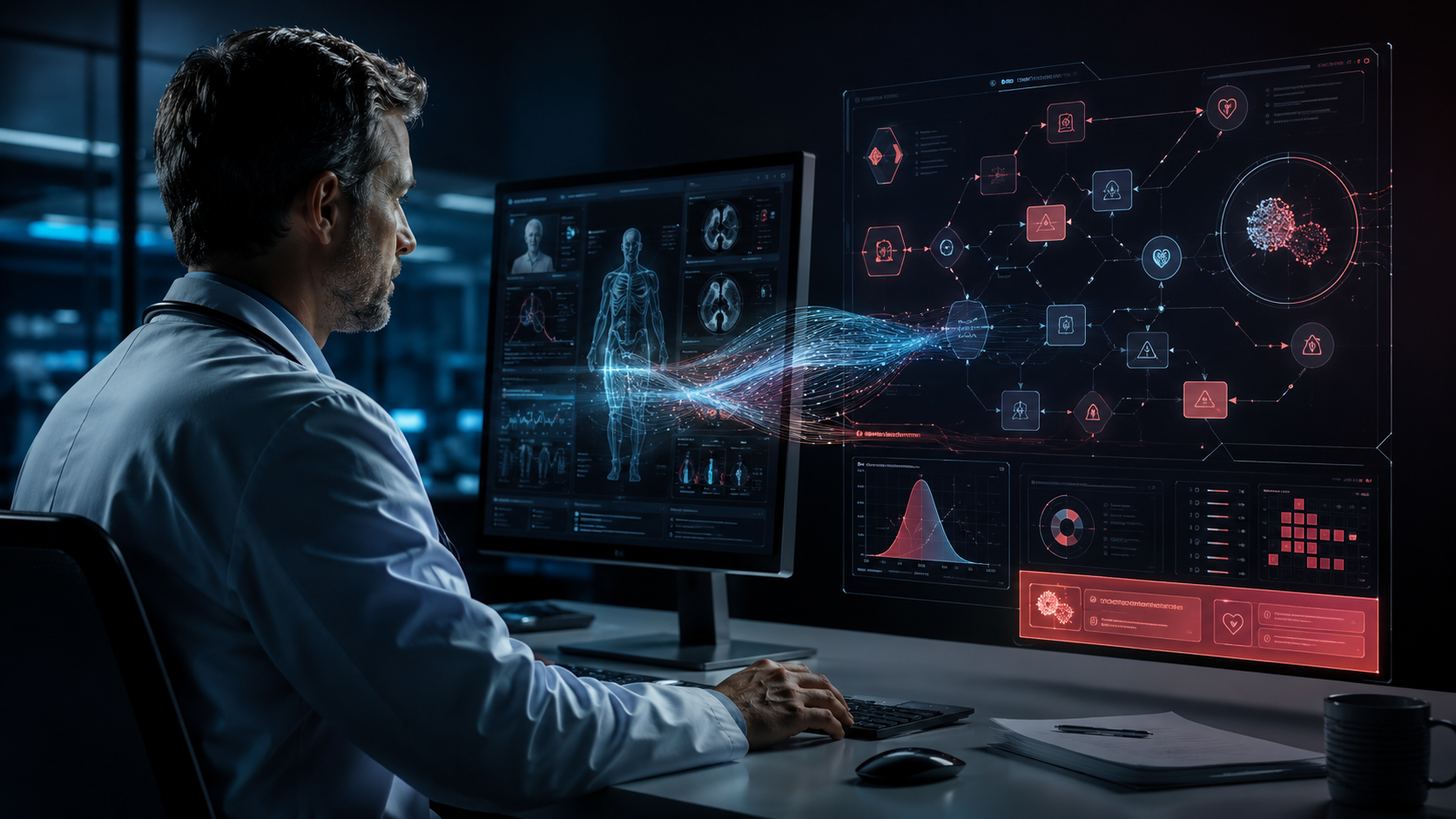
Clinical decision support (CDS) systems were designed to improve patient safety, reduce medical errors, and help clinicians make faster decisions. Yet in many hospitals and healthcare organizations, CDS alerts are routinely ignored.
Studies consistently show that clinicians override or dismiss 90–96% of clinical alerts. The issue is not that clinicians do not care about safety. The issue is that most CDS systems were architected around static rule engines that deliver too many low-value interruptions at the wrong time.
Modern healthcare organizations need a different approach.
The future of AI clinical decision support architecture is not about generating more alerts. It is about delivering context-aware, explainable, workflow-native recommendations that clinicians trust and actually use.
Why Traditional Clinical Decision Support Systems Fail
Most legacy CDS platforms were built around simple rules-based logic:
- IF medication A + medication B → show interaction alert
- IF creatinine elevated + contrast order → show renal warning
- IF duplicate order detected → show duplicate order alert
This architecture works for straightforward safety checks, but it breaks down at scale.
As organizations add thousands of rules, the system becomes noisy, difficult to maintain, and increasingly disruptive to clinician workflows. Eventually, clinicians stop paying attention because too many alerts lack urgency or relevance.
This creates what healthcare organizations commonly call “alert fatigue.”
But alert fatigue itself is not the root problem.
The real problem is poor CDS system design.
The Three Core Clinical Decision Support Architecture Models
Healthcare organizations typically deploy one of three CDS architecture approaches.
1. Rules-Based CDS Architecture
Rules-based clinical decision support relies on explicitly programmed logic trees.
Examples include:
- Drug-drug interaction checking
- Duplicate order detection
- Basic dosing recommendations
- Compliance and guideline reminders
Strengths of Rules-Based CDS
- Fully explainable and auditable
- Easy for clinicians to understand
- Strong regulatory familiarity
- Deterministic outputs
Limitations of Rules-Based CDS
- Requires constant manual maintenance
- Difficult to scale across large clinical environments
- Cannot detect unprogrammed patterns
- Generates excessive alert volume over time
Rules-based CDS works best for highly standardized clinical logic with clear if-then relationships.
2. Machine Learning-Based CDS Architecture
Machine learning-powered CDS systems analyze large volumes of clinical data to detect patterns and generate predictive insights.
Common AI clinical decision support use cases include:
- Sepsis prediction
- Readmission risk scoring
- Adverse event prediction
- Diagnostic support systems
- Clinical deterioration detection
Strengths of ML-Based CDS
- Detects complex multi-variable patterns
- Improves with additional data
- Supports predictive analytics
- Identifies subtle signals humans may miss
Limitations of ML-Based CDS
- Reduced explainability
- Model drift risk over time
- Regulatory complexity
- Requires large, high-quality datasets
This approach is strongest when identifying probabilistic patterns across large clinical populations.
3. Hybrid CDS Architecture (Recommended)
The most effective production CDS systems combine rules-based logic with machine learning.
Hybrid architecture separates responsibilities:
- Rules engines manage deterministic clinical safety checks
- ML models manage prediction and risk scoring
- A unified orchestration layer prioritizes and delivers recommendations
This approach balances explainability with predictive intelligence.
Example Hybrid CDS Workflow
Clinical Data Stream → Rules Engine → Alert Queue
                     → ML Models   → Prediction Queue
                                    ↓
                          Alert Prioritization Engine
                                    ↓
                          Context-Aware Alert Delivery
                                    ↓
                          Clinician Workflow in EHR
This architecture dramatically improves usability because clinicians receive fewer irrelevant interruptions while still getting critical safety guidance.
Organizations building scalable healthcare AI platforms increasingly adopt hybrid CDS models because they align better with real-world clinical workflows.
For healthcare organizations designing broader AI infrastructure, Healthcare Data Pipeline Architecture: From Ingestion to Real-Time Clinical Insights is a critical foundational component.
Solving Alert Fatigue with Context-Aware CDS Architecture
Reducing alert fatigue requires intelligent prioritization, filtering, and workflow awareness.
The goal is not fewer alerts.
The goal is delivering the right alert to the right clinician at the right time.
Alert Prioritization Framework
Modern CDS systems should stratify alerts into tiers.
Tier 1 — Interruptive Alerts
Reserved for potentially life-threatening scenarios:
- Severe allergic reactions
- Dangerous dosing errors
- Critical lab findings
These alerts interrupt workflows and require clinician acknowledgment.
Production goal:
- Less than 5% of total alerts
Tier 2 — Prominent Alerts
Clinically meaningful but non-critical alerts:
- Moderate drug interactions
- Renal dosing adjustments
- Duplicate order recommendations
Displayed prominently without hard workflow interruption.
Production goal:
- 10–20% of total alerts
Tier 3 — Informational Alerts
Non-urgent recommendations and contextual guidance:
- Educational reminders
- Population health indicators
- Preventive care suggestions
Displayed passively or on demand.
Production goal:
- 75–85% of total alerts
Contextual Filtering in AI Clinical Decision Support
High-performing CDS systems evaluate clinical context before generating alerts.
Patient Context
The system should understand:
- Existing chronic therapies
- Historical medication tolerance
- Longitudinal clinical patterns
For example, repeatedly alerting clinicians about a stable long-term medication creates unnecessary noise.
Clinician Context
Not all clinicians require the same guidance.
Examples:
- Cardiologists may not need basic cardiac medication alerts
- Residents may require expanded explanations
- Cross-coverage physicians may need enhanced contextual recommendations
This creates a more adaptive clinician experience while preserving safety.
Healthcare organizations implementing personalization strategies often combine CDS with The Adaptive UX Engine for Healthcare to dynamically tailor interfaces and alert presentation.
Workflow Context
The system should recognize:
- New medication orders
- Renewals
- Emergency workflows
- Inpatient vs outpatient contexts
Alerts that appear during renewals or repetitive workflows should be substantially reduced.
Institutional Context
Organizations should continuously monitor:
- Alert override rates
- Alert usefulness
- Clinician feedback
- Outcome impact
Alerts consistently overridden at extremely high rates may need redesign or removal.
CDS Hooks and EHR Integration
One of the most important healthcare interoperability standards for CDS is HL7 CDS Hooks.
CDS Hooks enables clinical decision support services to integrate directly into EHR workflows without requiring deeply customized implementations.
How CDS Hooks Works
- The EHR reaches a workflow trigger point
- Clinical context is sent to the CDS service
- The CDS engine evaluates the request
- Recommendations return as structured “cards”
- The EHR displays recommendations inline
Common CDS Hook Trigger Points
patient-view
Triggered when a clinician opens a patient chart.
order-select
Triggered when a medication or order is selected.
order-sign
Triggered when orders are submitted.
encounter-start
Triggered at the beginning of a patient encounter.
Why CDS Hooks Matters
CDS Hooks standardization allows healthcare organizations to:
- Reduce custom EHR integrations
- Improve scalability
- Support Epic and Cerner interoperability
- Deploy modular CDS services faster
Healthcare AI systems built for production environments increasingly rely on interoperability-first architecture patterns to reduce long-term maintenance complexity.
FDA Guidance for AI Clinical Decision Support
Healthcare AI teams must understand FDA guidance around clinical decision support software.
Under Section 3060 of the 21st Century Cures Act, certain CDS systems may qualify as non-regulated software if specific criteria are met.
CDS May Be Exempt from FDA Regulation When:
- The software does not analyze medical images or signals directly
- The software displays or analyzes medical information
- The software is intended for healthcare professionals
- The clinician can independently review the basis for recommendations
In practice, this means explainability is critical.
If an AI system provides recommendations without showing supporting rationale, it is more likely to face regulatory scrutiny.
If the system clearly explains:
- Why the recommendation occurred
- Which clinical variables contributed
- Confidence levels
- Supporting evidence
…it is more likely to align with FDA exemption guidance.
This is one reason explainable AI architecture is becoming a core requirement in healthcare AI production systems.
Organizations evaluating enterprise healthcare AI strategy should also review The Complete Guide to AI-Powered Healthcare Software in 2026 for broader implementation considerations.
Key Design Principles for Production CDS Systems
Healthcare organizations building AI-powered CDS platforms should prioritize:
- Hybrid rules + ML architecture
- Workflow-native EHR integration
- Explainable AI outputs
- Context-aware alert delivery
- Continuous monitoring for model drift
- Alert prioritization and suppression logic
- Clinician trust and usability
The most successful CDS systems are not necessarily the most complex.
They are the systems clinicians barely notice because recommendations arrive naturally within the workflow, with minimal disruption and maximum relevance.
What HyperTrends Builds
HyperTrends designs and implements AI-powered clinical decision support systems for healthcare organizations building production-grade healthcare AI infrastructure.
Our work includes:
- Hybrid CDS architecture design
- AI model integration
- Alert fatigue reduction systems
- Explainable AI implementation
- CDS Hooks integration
- Healthcare interoperability architecture
- Real-time healthcare analytics platforms
Healthcare organizations need CDS systems clinicians trust — not systems clinicians automatically dismiss.
Ready to build clinical decision support architecture that improves clinician adoption and reduces alert fatigue? Contact HyperTrends to discuss your healthcare AI strategy.

