
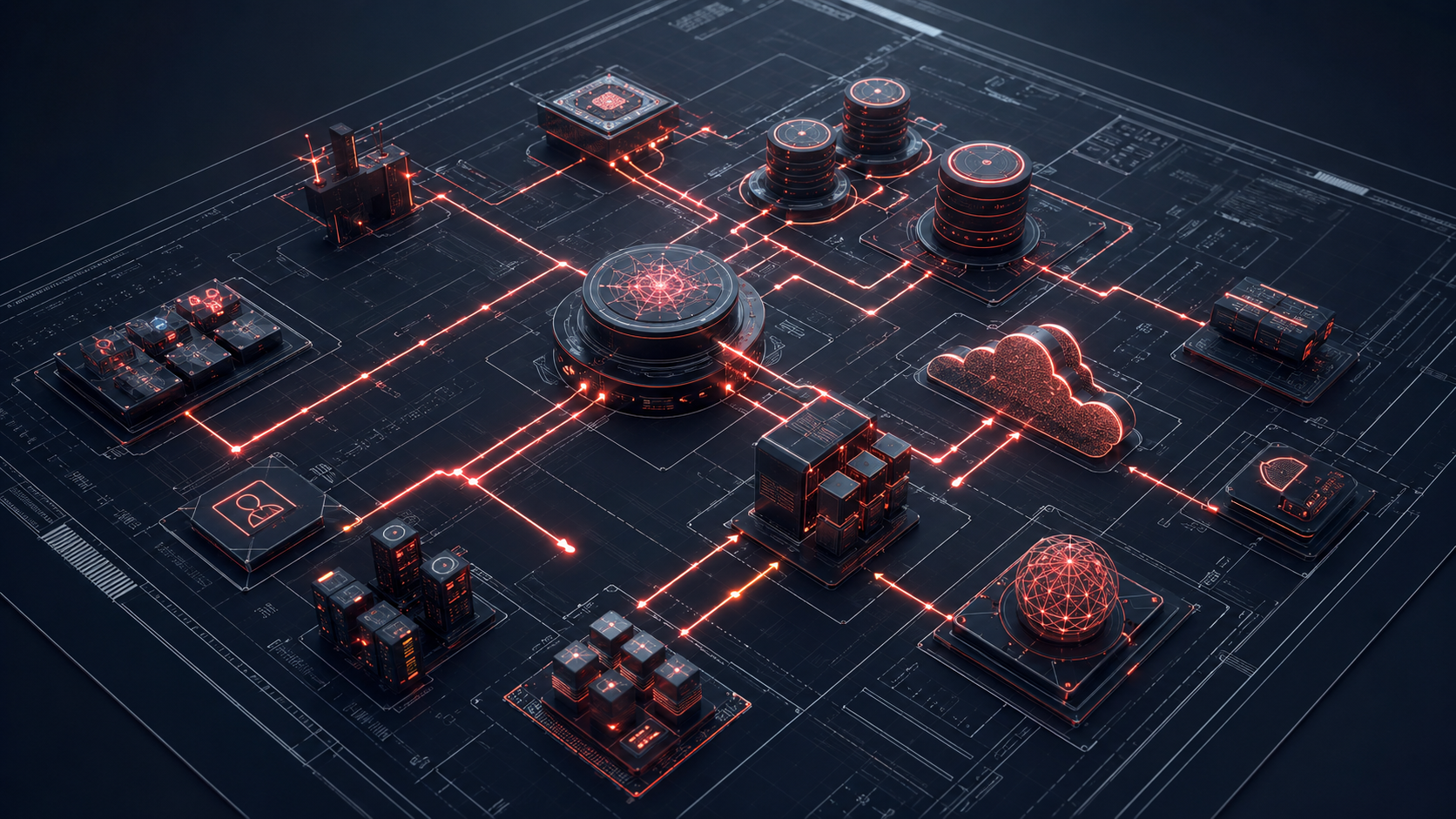
Most enterprise AI projects fail not because the AI doesn’t work, but because the architecture cannot support it.
According to Gartner, approximately 85% of AI projects fail to achieve their intended business outcomes. The issue is rarely model accuracy. More often, organizations underestimate the complexity of the surrounding ecosystem: data pipelines, integration layers, deployment infrastructure, observability, governance, cost management, and human oversight.
AI is not a feature you bolt onto an existing application.
It is an architectural commitment.
The model itself is only a small portion of the overall system. The remaining infrastructure determines whether AI creates enterprise value or operational risk.
This guide explores the complete enterprise AI architecture stack—from AI agents and LLM integration to agentic payments and cloud-native deployment.
What Is Enterprise AI Architecture?
Enterprise AI architecture is the framework that enables AI systems to operate reliably, securely, and efficiently in production environments.
A complete architecture typically includes:
- Data infrastructure
- Model serving infrastructure
- Agent orchestration
- Governance and compliance controls
- Monitoring and observability
- Cost management systems
- Human-in-the-loop workflows
Organizations that focus only on selecting the right model often discover that the real challenges emerge after deployment.
Production AI requires systems that scale, recover from failures, remain compliant, and generate measurable business outcomes.
Why Do Most Enterprise AI Projects Fail?
Most AI failures occur because organizations design around the model instead of designing around the system.
Successful enterprise AI deployments require:
- Reliable data pipelines
- Secure integration layers
- Observability and monitoring
- Governance frameworks
- Cost controls
- Human oversight
- Production deployment pipelines
Without these components, even the most capable model eventually becomes a liability.
What Are the Different Levels of AI Agents?
AI agents exist on a spectrum of sophistication.
Level 1: Rule-Based Chatbots
Rule-based systems rely on predefined logic and decision trees.
Characteristics:
- No learning capability
- Static responses
- Limited flexibility
Level 2: RAG-Powered Assistants
Retrieval-Augmented Generation (RAG) combines an LLM with external knowledge retrieval.
Capabilities include:
- Answering questions accurately
- Accessing enterprise documentation
- Providing source attribution
Limitations:
- Cannot independently take meaningful actions
For a deeper exploration, see AI Agent Architecture for Enterprise: From Chatbot to Autonomous Workflow.
Level 3: Tool-Using Agents
Tool-using agents connect language models with external systems.
Examples include:
- Sending emails
- Querying databases
- Creating CRM records
- Updating business systems
Level 4: Planning Agents
Planning agents can:
- Break objectives into subtasks
- Sequence execution steps
- Re-plan when failures occur
Level 5: Autonomous Multi-Agent Systems
These systems coordinate multiple specialized agents under supervisory control.
Capabilities include:
- Continuous operation
- Agent collaboration
- Cross-functional execution
- Adaptive decision making
Most organizations claiming to have AI agents today are still operating at Level 2.
What AI Agent Architecture Patterns Work in Production?
Several architecture patterns consistently outperform others in enterprise environments.
Single Agent Architecture
A single LLM connected to tools.
Best for:
- Internal assistants
- Customer support
- Narrow workflows
Router + Specialist Architecture
A routing layer classifies requests and directs them to specialized agents.
Best for:
- Multi-domain support
- Enterprise operations
Orchestrator + Worker Architecture
An orchestrator distributes work across multiple workers.
Best for:
- Research
- Analysis
- Content generation
Planner-Executor Architecture
Planning and execution are separated into distinct components.
Best for:
- Multi-step workflows
- Complex operational processes
Supervised Autonomous Swarms
Multiple autonomous agents operate under governance and supervision.
Best for:
- Enterprise automation
- Continuous operations
Regardless of architecture pattern, every production system requires:
- Guardrails
- Observability
- Memory systems
- Cost management
- Error recovery
For a complete breakdown, read Building Production AI Agent Systems: Architecture Patterns That Scale.
Should Enterprises Use RAG or Fine-Tuning?
One of the most common enterprise AI questions is whether to use RAG or fine-tuning.
The answer depends on the problem being solved.
Use RAG for Knowledge Retrieval
RAG stores knowledge outside the model and retrieves information at runtime.
Advantages:
- Easy updates
- Lower costs
- Source attribution
- Strong compliance capabilities
Use RAG when:
- Information changes frequently
- Citations are required
- Budget efficiency matters
Use Fine-Tuning for Behavioral Changes
Fine-tuning modifies model behavior through additional training.
Advantages:
- Consistent outputs
- Faster inference
- Specialized reasoning
Use fine-tuning when:
- You need a specific output format
- You require domain-specific behavior
- Latency is critical
Hybrid Architectures Win
For most enterprise applications, the optimal architecture is:
Fine-Tuning for behavior + RAG for knowledge
Learn more in Enterprise LLM Integration: RAG, Fine-Tuning, and When to Use Each.
What Are Agentic Payments?
Agentic payments enable AI agents to discover, purchase, and consume services autonomously.
Four protocols are emerging as foundational infrastructure for the agent economy.
| Protocol | Creator | Rail | Best For |
|---|---|---|---|
| x402 | Coinbase | USDC | API micropayments |
| ACP | Stripe + OpenAI | Card Networks | Enterprise B2B |
| AP2 | Agnostic | Governance and auditability | |
| TAP | Visa | Visa Network | Established merchant ecosystems |
These systems are often complementary rather than competitive.
A common architecture may use:
- AP2 for authorization
- ACP for discovery
- x402 for execution
Read Agentic Payments: The Complete Protocol Comparison for a full analysis.
The broader implication is significant.
Traditional SaaS was built around monthly subscriptions.
AI agents purchase outcomes, transactions, and API calls.
Companies that adopt usage-based monetization models are positioned to capture value from the emerging agent economy.
Additional resources:
- Your API Is a Revenue Stream
- The Death of SaaS Subscriptions?
- What Happens When Your Customer Is an AI Agent?
How Does Adaptive UX Improve Enterprise Software?
Traditional enterprise applications treat every user the same.
Adaptive UX dynamically changes the interface based on observed user expertise.
Expert Users See
- Dense information layouts
- Keyboard shortcuts
- Batch operations
- Advanced controls
New Users See
- Guided workflows
- Contextual explanations
- Safety mechanisms
Progressive Mastery
As users become more experienced, the interface evolves with them.
This creates a powerful competitive advantage.
Each interaction improves the system’s understanding of the user, making the experience increasingly personalized.
Discover how this works in AI-Powered UX: How the Adaptive UX Engine Reshapes Enterprise Software.
What Is a 10x Employee?
The convergence of AI agents, orchestration systems, and adaptive software is creating a new operating model.
One person, supported by AI systems, can now produce the output that previously required an entire team.
This is not theoretical.
Organizations are already using AI to accelerate:
- Development
- Design
- Testing
- Deployment
- Analytics
The result is significantly higher productivity with dramatically lower operating costs.
Explore the framework in The 10x Employee: How One Person Powered by AI Agents Can Replace a Team of Five.
What Infrastructure Is Required for Enterprise AI?
Successful enterprise AI systems generally rely on four deployment patterns.
Serverless Inference
Best for:
- Low-volume workloads
- Pay-per-request economics
Auto-Scaling Clusters
Best for:
- Consistent demand
- High availability
Model Serving Pipelines
Best for:
- Multi-model environments
- Cost optimization
Many organizations reduce inference costs by more than 70% through intelligent model routing.
Batch Processing and Caching
Best for:
- High-volume workloads
- Maximum efficiency
Additional infrastructure requirements include:
- GPU orchestration
- Observability
- Audit logging
- Model versioning
- Compliance controls
- Data residency management
For a deeper dive, read Cloud-Native AI Architecture: Designing for Cost, Speed, and Compliance.
The Complete Enterprise AI Architecture
User Experience Layer
- Adaptive UX Engine
- Human-in-the-Loop Workflows
- Approval Systems
AI Agent Layer
- Agent Orchestration
- Tool Registry
- Memory Systems
- Guardrails
Intelligence Layer
- LLM Integration
- Model Serving
- Monitoring
- Evaluation
Commerce Layer
- Agentic Payments
- Usage Metering
- API Monetization
Infrastructure Layer
- Cloud-Native Platforms
- Observability
- Cost Management
- Compliance
Each layer provides value independently.
Together, they create a complete enterprise AI architecture capable of shipping, scaling, and sustaining production workloads.
What Does HyperTrends Build?
HyperTrends designs and implements complete enterprise AI architectures.
Our expertise includes:
- AI Agent Systems
- LLM Integration
- Agentic Payments
- Adaptive UX
- Cloud Infrastructure
- Production Deployment
We build production systems that ship—not proof-of-concepts that remain stuck in demos.
If you’re evaluating enterprise AI initiatives, the architecture decisions you make today will determine whether your AI investment becomes a competitive advantage or another failed experiment.
Ready to build enterprise AI that actually works in production?
Schedule a consultation and let’s design your AI architecture.
Frequently Asked Questions
What is enterprise AI architecture?
Enterprise AI architecture is the combination of systems, infrastructure, governance, and workflows required to deploy AI successfully in production.
What is the difference between RAG and fine-tuning?
RAG retrieves external knowledge at runtime, while fine-tuning changes model behavior through additional training.
What are AI agents?
AI agents are software systems capable of reasoning, using tools, making decisions, and executing tasks autonomously.
What are agentic payments?
Agentic payments enable AI systems to discover, authorize, and pay for services without direct human involvement.
What is the best architecture for enterprise AI?
Most organizations benefit from a layered architecture combining AI agents, hybrid LLM integration, observability, governance, adaptive UX, and cloud-native infrastructure.

